Airbnb vs Booking.com: 8.7M Listings Across 240 Countries (2026 Data)
A data breakdown of global vacation rental listings across Airbnb and Booking.com, and what it means for property managers choosing where to list.

Posted on - February 22nd 2026
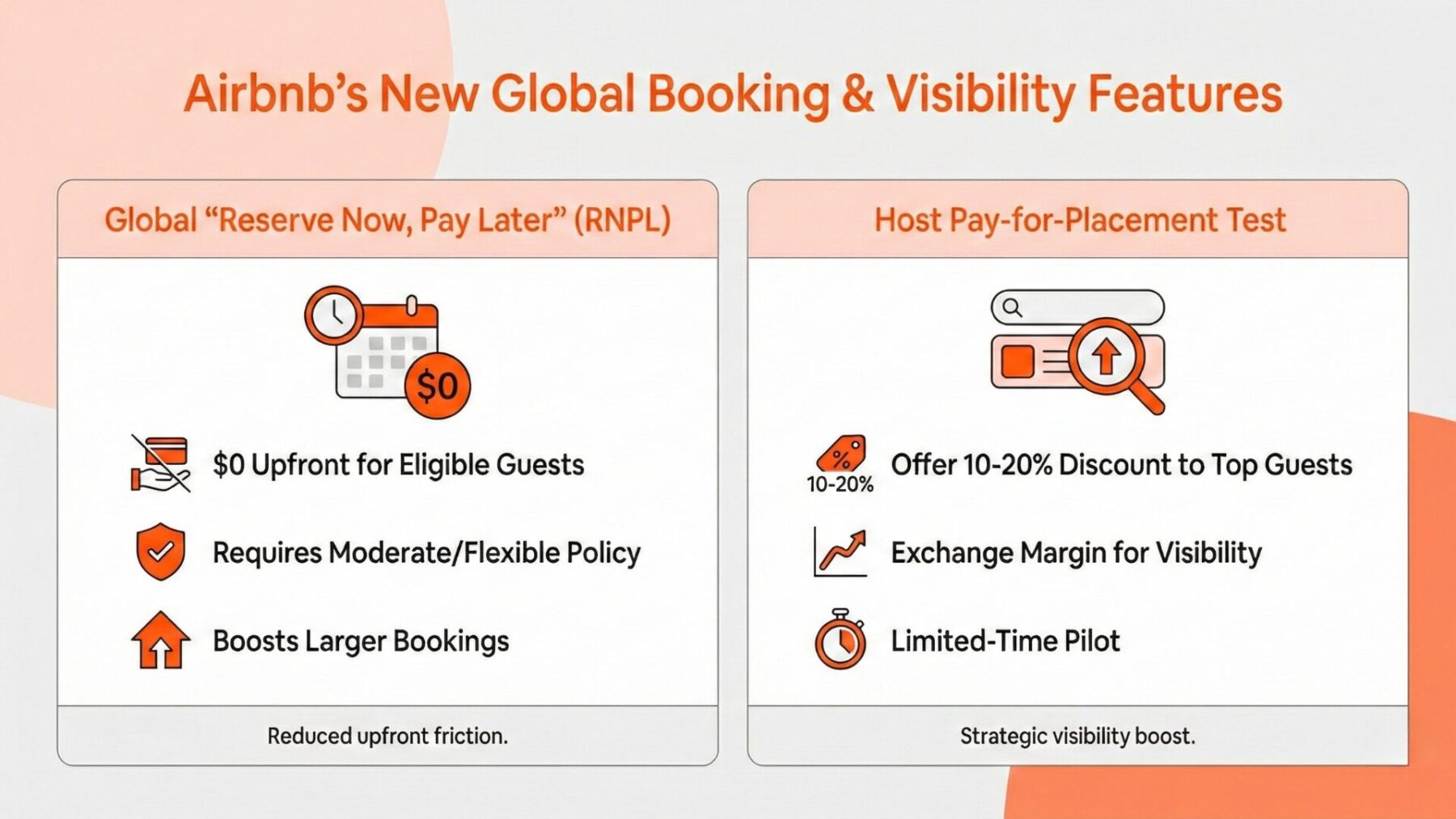
Airbnb is rapidly evolving its booking and visibility mechanics, shifting from a purely performance-based algorithm to one that leans heavily on payment flexibility and yield management. Following recent Q4 earnings data and successful US trials, two major updates are reshaping the platform for both hosts and travellers: the global rollout of the $0-upfront ‘Reserve Now, Pay Later’ (RNPL) programme and a new test tying search visibility directly to host-funded discounts.
Here is a validated breakdown of what these changes mean and the data driving them.
After a successful launch in the US last summer, Airbnb is expanding its RNPL feature worldwide. The data driving this rollout is clear: the platform wants to remove the friction of upfront payments, particularly for larger reservations and group travel.
How it Works
Guests booking eligible listings can secure their reservation with $0 due upfront, paying the balance closer to their check-in date. This sits alongside other flexible options like Klarna and ‘Pay Part Now, Part Later’. It applies exclusively to listings with a moderate or flexible cancellation policy. Hosts using firm or strict policies are exempt from this feature.
The Data
During the recent Q4 earnings call, Airbnb revealed that RNPL saw over 70% adoption among eligible bookings. While the aggregate cancellation rate rose by about 1%, the overall increase in booked nights made the trade-off highly worthwhile for the platform. Furthermore, Q4 Average Daily Rates (ADR) hit $168 (a 6% year-over-year increase), indicating that RNPL is successfully shifting bookings toward larger, premium homes with four or more bedrooms where upfront costs are usually a barrier.
The Traveller Sentiment
A joint survey with Focaldata highlighted that 60% of US travellers prioritise flexible payment options. Crucially, 42% reported missing out on preferred accommodation because of delays in coordinating payments with co-travellers—a direct conversion bottleneck that RNPL is designed to solve.
Alongside flexible payments, Airbnb is testing a new lever for search ranking. For the first time, the platform is experimenting with an explicit pay-for-placement model, allowing established hosts to trade profit margins for a boost in the search algorithm.
The Promotion
For reservations booked between 12 February and 12 March, selected hosts can offer a 10%, 15%, or 20% discount to highly rated guests (those with a 4.8+ rating and at least three reviews).
The Reward
In exchange for fully funding this discount, hosts receive a search visibility boost and a special badge on their listing. This promotion can be toggled off at any time and stacked with other active discounts.
The Broader Strategy
This is fundamentally different from Airbnb’s standard 20% new-listing discount, which exists to solve the “cold-start” problem. This new test mimics the discount-for-visibility structures long used by airlines and competitors like Booking.com (Genius) or Vrbo. It also aligns directly with CEO Brian Chesky’s recent Q4 comments regarding new loyalty programmes, which he described as a potential “massive accelerant” for growth, building upon the foundations laid by the HotelTonight rewards programme.
Airbnb is giving hosts more tools to capture demand, but they require careful navigation and strategic trade-offs.
On the booking side, RNPL is a proven conversion driver. However, participating requires adopting a moderate or flexible cancellation policy. Opting for a firm or strict policy protects your calendar but means opting out of RNPL entirely, which may impact overall search visibility and volume in a market that heavily favours flexibility.
On the visibility side, the new discount test offers a straightforward way to drive eyeballs to a listing during slower booking windows. Sophisticated operators should treat this discount like any other customer acquisition cost. It is essential to rely on your data: measure whether the search boost drives genuine incremental growth, or if it simply reduces revenue on existing demand.