
Wire Weekly: Global short-term rental & hospitality news
This week in STR: Airbnb Q1 results, TikTok moves into travel bookings, shifting demand patterns, and Lodgify’s new AI tools reshape direct bookings.

Posted on - February 25th 2026
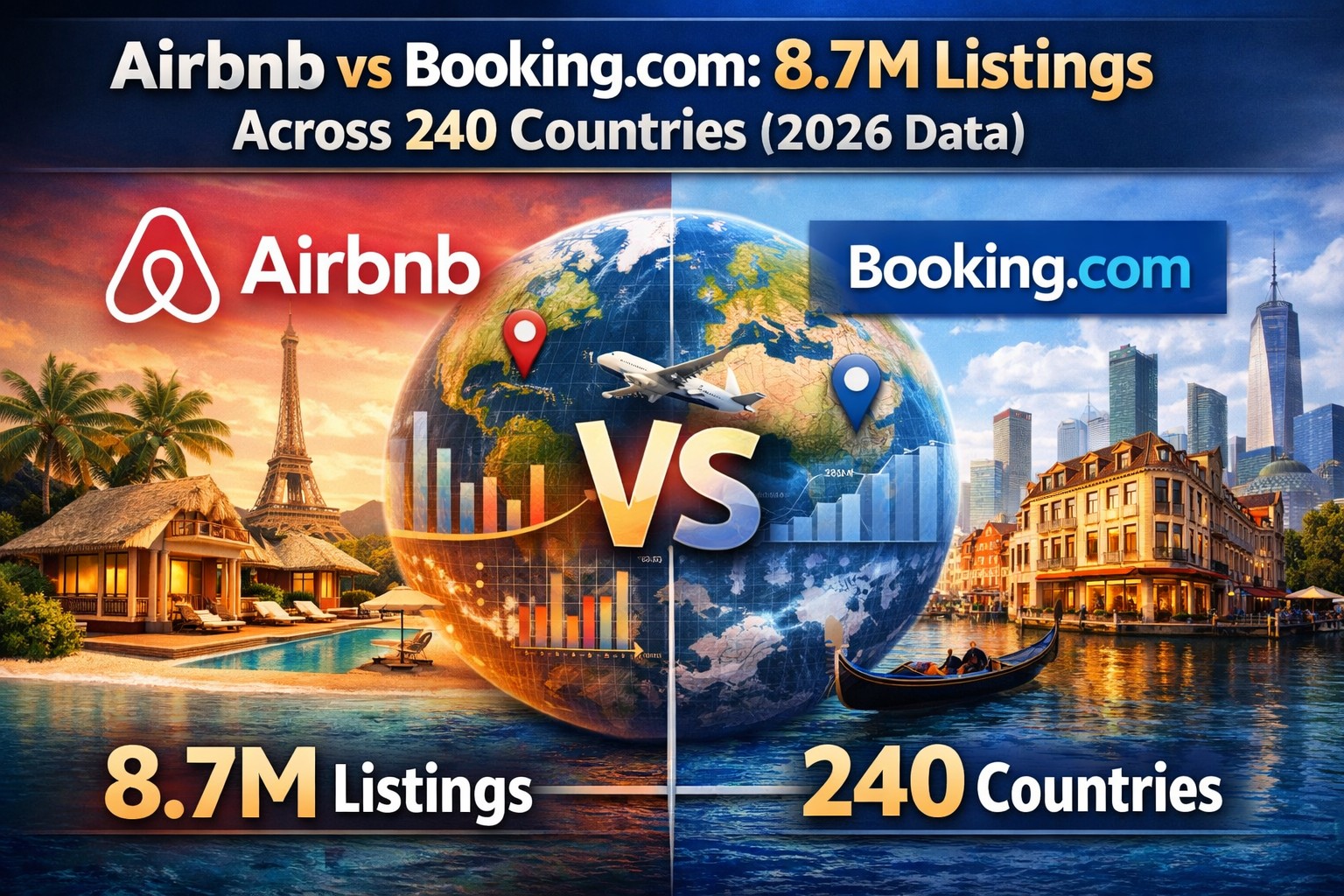
If you manage vacation rentals, you already know the two biggest platforms. But do you know how they actually compare — country by country, across 240 markets?
We built an interactive report that took over a week to compile, scanning every advertised listing on both Airbnb and Booking.com across all 240 countries. This is not sampled data or an estimate. It is a full snapshot of every listing currently advertised on both platforms as of January 2026.
You can explore the full interactive report yourself: filter by country, compare Airbnb vs Booking.com side by side, and see exactly where listings are concentrated. More on that below.
Airbnb currently advertises approximately 5.3 million listings worldwide. Booking.com sits at around 3.4 million. Combined, that is roughly 8.7 million vacation rental listings spread across 240 countries.
Airbnb has about 56% more advertised listings globally than Booking.com. But that ratio is not the same everywhere — and that is where things get interesting for operators.
Not every market looks the same
In some countries, Airbnb dominates heavily. In others, Booking.com holds its own or even leads. The split depends on traveller habits, platform history, and how each channel invested in that market.
Where Airbnb leads: The US is the single largest market on both platforms, but Airbnb’s lead there is substantial. Similarly, countries like Brazil, Australia, and Canada skew heavily towards Airbnb.
Where Booking.com is strong: In much of Europe — particularly France, Italy, Spain, and the UK — Booking.com has a much larger share than its global average would suggest. In several European markets, the two platforms are closer to parity. Booking.com’s hotel heritage gives it a built-in audience of travellers who search there first.
Where both are growing: Markets across Southeast Asia, the Middle East, and parts of Africa show rapid growth on both platforms. These are the markets where early distribution decisions will matter most over the next few years.
1. Listing on one platform is leaving money on the table
With 5.3 million listings on Airbnb and 3.4 million on Booking.com, travellers are searching on both. If you are only on Airbnb, you are invisible to millions of Booking.com bookers — and vice versa. The overlap in traveller audience is smaller than most operators assume.
2. Your market ratio should influence your strategy
If you operate in a market where Booking.com has strong penetration, ignoring it means ignoring a large share of potential bookings. Use the interactive report to check the data for your specific country. A market where Booking.com has 40-50% of listings likely has strong demand on that channel.
3. Booking.com rewards operators who actively manage promotions
Here is where the two platforms differ significantly. Airbnb’s search algorithm is relatively opaque. Booking.com, on the other hand, has a structured promotion system — Genius levels, mobile rates, campaign deals, early booker deals, and more — that directly influences your ranking in search results.
Properties that actively manage these promotions consistently outrank those that just list and wait. The platform explicitly rewards operators who participate in its promotion programmes with higher visibility.
4. The 240-country spread means localised demand
Booking.com’s country rate and targeting promotions let you offer specific rates to travellers from specific countries. This is particularly powerful if your properties attract international guests. A property in Spain can show different rates to UK travellers vs German travellers vs domestic bookers — all through the same listing.
Many property managers set up their listings on both platforms and stop there. But the real revenue difference comes from how you manage each channel, not just whether you are listed.
On Booking.com specifically, there are 10 different promotion types that can be stacked to improve ranking without reducing your net revenue. The key is using your PMS markup to create headroom — so promotions apply on top of an increased calendar price, and your target price stays protected.
This is not about discounting. It is about restructuring how the same price is presented to maximise visibility.
The full interactive report lets you filter by country, compare platform totals, and see exactly how listings are distributed in your market. The data covers every listing currently advertised on both Airbnb and Booking.com — gathered over the course of a week to ensure completeness across all 240 countries.
You can access the interactive report for free at mydatavalue.com
The vacation rental market is not one market — it is 240 markets, each with a different balance between Airbnb and Booking.com. Smart operators look at the data for their specific region and build their distribution and pricing strategy accordingly.
The numbers are clear: both platforms are massive, both are growing, and the operators who actively optimise on both will capture the most bookings.
—
Data sourced from myDataValue’s global property database. The snapshot covers every listing currently advertised on Airbnb and Booking.com across 240 countries, compiled over one week in January 2026. Explore the interactive report for free at mydatavalue.com