For years, the short-term rental industry has been described through the language of hospitality, entrepreneurship and distribution.
Listings.
Channels.
Occupancy.
Guest experience.
Operations.
All of that remains true. However, it is no longer sufficient to explain how the sector functions.
A shift in how the industry actually operates
Over the past decade, the industry has quietly evolved into a more complex and structurally mature technology ecosystem.
That shift matters because it changes the way the market should be understood.
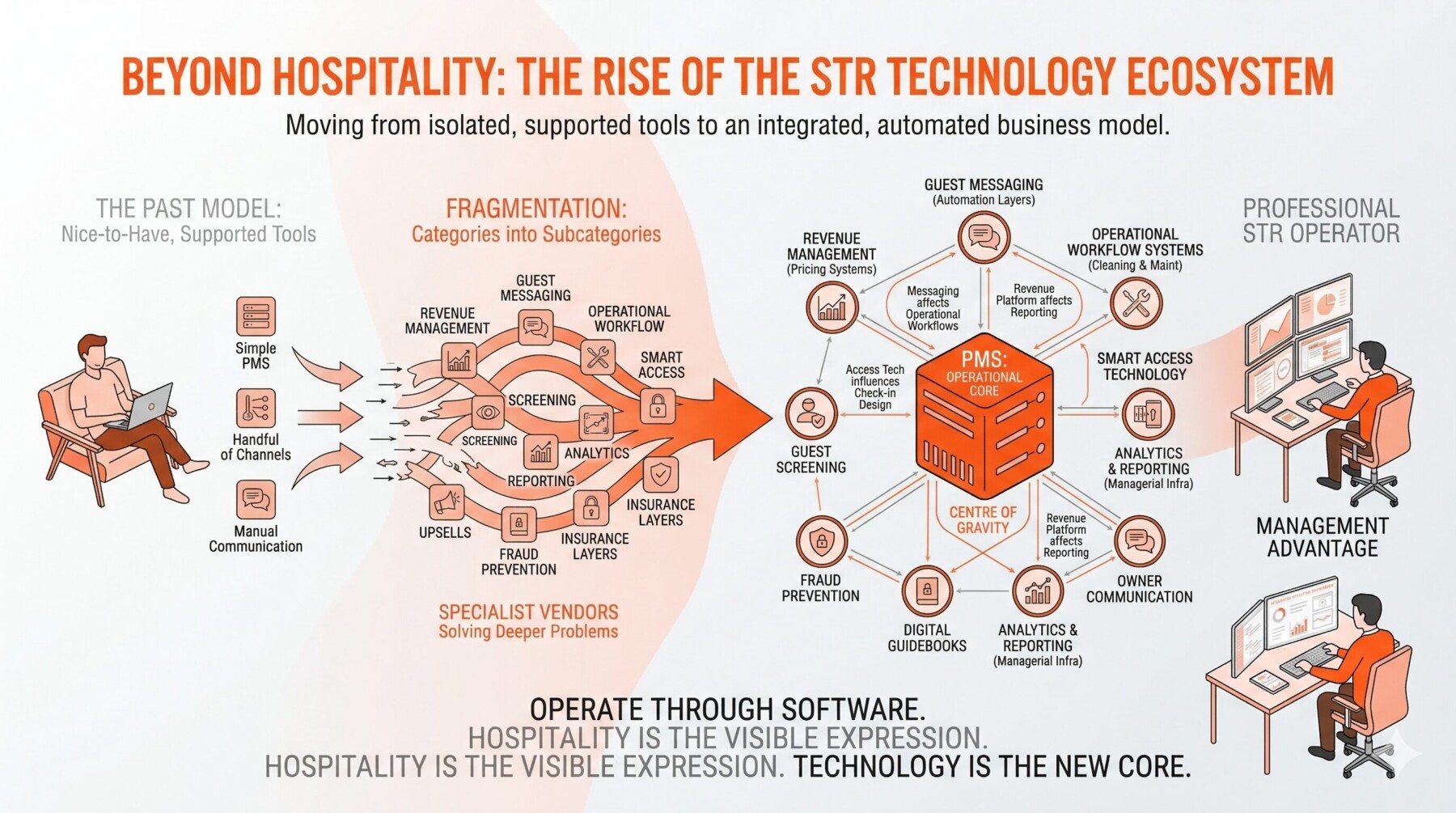
The earlier version of the sector was operationally lighter. A host or small operator could manage properties with a relatively small digital footprint. Bookings came through a handful of channels, communication was more manual, and coordination often depended on personal oversight rather than systems design. Technology supported the business, but it did not define its operating structure.
Technology moves to the core
That is no longer the case for any serious operator.
Today, pricing is shaped by systems that react to demand faster than manual judgment could. Communication flows through automation layers designed to maintain consistency, speed and service coverage. Guest arrival is increasingly handled through smart access technology. Cleaning and maintenance depend on workflow systems, and reporting is no longer an afterthought but part of the managerial infrastructure.
The important point is not simply that there are more tools than before. It is that technology has moved from the edge of the business to its operational core.
The modern property management company does not merely use software. It operates through it.
From tools to ecosystem
This is a classic sign of market maturity. As industries professionalise, they tend to produce specialist vendors solving narrower, deeper and more specific problems. Monolithic processes fragment into categories. Categories become sub-categories. Distinctions appear between “nice-to-have” tools and critical infrastructure. The market becomes richer, but also harder to navigate.
That is exactly what has happened in STR.
The technology landscape now spans revenue management, guest messaging, operational workflow, smart access, screening, analytics, reporting, owner communication, upsells, fraud prevention, digital guidebooks, insurance layers and more. Even where categories appear familiar on the surface, their actual positioning often differs meaningfully depending on portfolio type, geography and operating model.
This is where the conversation needs to become more sophisticated.
The industry often still speaks about technology in a relatively flat way, as though it were simply a matter of “which tool is best”. That framing belongs to a simpler market. In a genuine ecosystem, the more relevant question is not “which tool wins?” but “how is the market structured, and what kind of operating environment is this business actually trying to build?”
That question matters because software decisions are no longer isolated. They sit inside a larger stack. A revenue platform affects reporting. A messaging system affects operational workflows. Access technology influences check-in design and guest support. A PMS does not just store information; it acts as the centre of gravity for the rest of the operation.
Once that happens, technology ceases to be a supporting category. It becomes part of the business model.
This is also why the idea of the STR sector as a purely hospitality space increasingly feels incomplete. Hospitality remains the customer-facing expression of the industry. But under the surface, many of its most important performance levers now sit inside systems, integrations, workflows and digital infrastructure.
What this means for the industry
That has consequences for everyone involved.
For operators, it means the ability to understand systems is becoming a management advantage. For vendors, it means product visibility alone is not enough; category clarity and contextual relevance matter more than many realise. For the ecosystem more broadly, it means the industry needs better ways of mapping and understanding itself.
The next stage of maturity in STR may not be defined by the invention of dramatically new tools. It may be defined by something less visible but ultimately more important: the industry’s ability to understand the ecosystem it has already built.
That is the conversation now beginning.
And it is one worth taking seriously. This is the first article in a short series exploring how the STR ecosystem is evolving, and why that evolution changes the questions operators and vendors need to ask. Stay tuned.
Follow SCALE Connect on Linkedin