
The PMS is dead: How AI Agents will change the ‘tech stack’ as we know

Posted on - November 8th 2025

The AI agents are already among us – and they’re here to fundamentally change how software and applications operate, including conventional Property Management Systems (PMS).
These intelligent systems can understand a request, break it down into sub-tasks, problem-solve, and execute autonomously. The most mainstream example you are likely to have heard of is OpenAI’s “Operator” which can book travel for a guest with minimal human intervention.
Unlike traditional software – which requires manual input and rigid architecture – agents fluidly “communicate” with other AI systems or via Application Programming Interfaces (APIs). This renders static, pre-programmed software increasingly obsolete.
The transformation is unfolding rapidly across industries, and hospitality is no exception. The conventional, all-in-one PMS, once the backbone of operations, will soon be replaced by agile, AI-driven solutions. Instead of navigating clunky dashboards or juggling multiple systems, property managers will rely on agents to handle tasks seamlessly in the background
To use a fictional reference: Tony Stark doesn’t open an Excel spreadsheet to solve a problem – he gets J.A.R.V.I.S to do it. Sooner than we think, hospitality businesses will do the same.
How agents are disrupting conventional PMS
Traditional PMS software has long been a nerve center in operations, managing everything from reservations and check-ins to guest data and financial reporting. However, they are completely reliant on human intervention and integrations with multiple, often fragmented, third-party applications to keep up with new technology.
And despite efforts to create all-in-one solutions, the hospitality tech landscape remains a highly fragmented one. Property managers are still to this day inefficiently toggling between PMS, CRM, RMS, and other single-purpose software.
Agents, on the other hand, don’t need to navigate rigid software interfaces. Instead, they “talk” with other agents and various systems through APIs, making decisions, handling highly specialized tasks, and optimizing workflows in real time.
Here are some examples of hospitality agents:
- Proactive CRM and Guest Experience Agent (TheNew Group) – An agent able to pull information about upcoming guests, check for returning ones, check for birthdays of the guest, check for potential requests from the arriving guests, analyse all reservations, booking, guest comments and provide a summary to the front desk.
- Corporate Sales Agent (Triple) – Analyzes company production data, compares year-over-year performance, and recommends which corporate accounts sales teams should focus on to drive demand.
- Onboarding Agent (UNA) – It automatically gathers property details, configures the property setup, and trains an AI booking agent to handle reservations seamlessly – enabling a faster and more efficient onboarding process.
It’s likely that within the next five years, the traditional PMS as we know it will evolve into passive data repositories serving compliance and financial needs, while agents like the ones above take over active management of operations. With AI in the driver’s seat, there is not much need for standalone software solutions.
Your agents talking to the guests’ agents
Travelers are adopting AI at record light speed. They’re already using generative AI and large language models such as ChatGPT to plan their travel, using it as more of an advanced search engine. Instead of using traditional booking channels like OTAs and websites, agents will handle bookings directly based on preferences, past behavior, and real-time pricing.
It could work like this. A traveler may simply tell their agent to “book me a holiday villa in Bali, with three bedrooms, toddler-friendly, with pool-fence and cot, within five minutes to the beach, early check-in,” and the agent will negotiate the best deal, bypassing traditional booking platforms entirely.
In this brave new world, guest-facing agents will interact directly with the accommodation agents, exchanging information seamlessly. For any hospitality business, ensuring their systems are “AI-friendly” is a necessity rather than an option.
Preparing for an AI-agent-first world
Property managers must start preparing for this shift now. The winners in this transformation will be those who embrace API-driven ecosystems, enabling agents to connect, automate, and optimize their operations. Here’s where to start: experiment with an API-first approach. Explore fully open and modular systems that can ensure seamless integration between your system and agents, allowing for real-time automation and decision-making. Then you can start implementing AI-driven automation. No-code and low-code automation tools already exist in the market so they really don’t require much tech expertise.
Avoiding the ‘Kodak Moment’
The hospitality industry has historically been slow to adopt technological change, often waiting until disruption is unavoidable. However, the pace of AI evolution is unprecedented. Companies that fail to adapt risk becoming obsolete, much like Kodak in the age of digital photography. The all-in-one PMS as we know it will soon be a relic of the past, and the future of hospitality tech is about being AI-ready.
Related Articles
Data & Market Trends
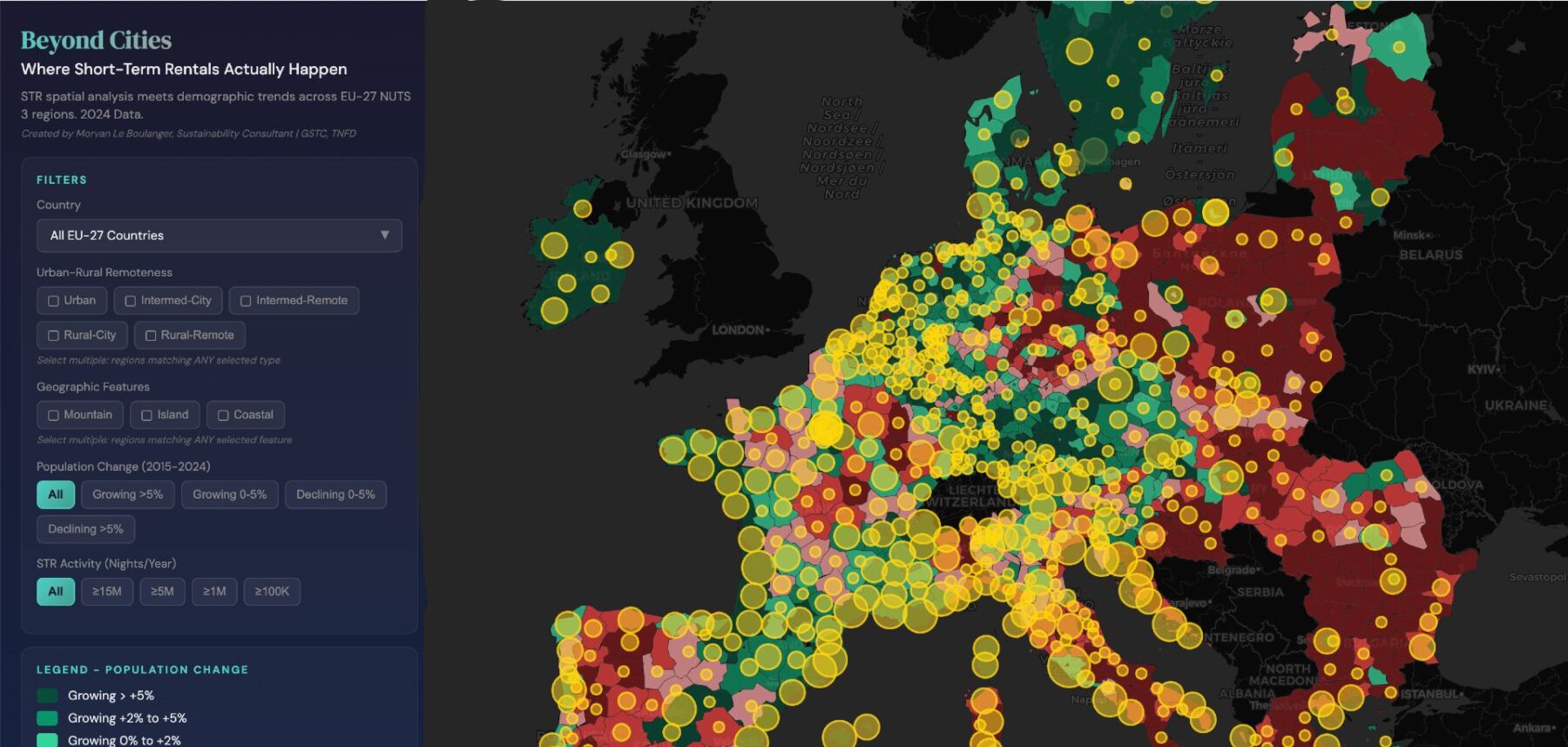
Beyond Cities: Where short-term rentals actually happen
More than half of Europe’s short-term rental activity happens outside cities. A data-led look at STR geography and destination management.
Fresh from the press
Data & Market Trends
Beyond Cities: Where short-term rentals actually happen
More than half of Europe’s short-term rental activity happens outside cities. A data-led look at STR geography and destination management.