Technology stacks in STR rarely appear through some grand design exercise.
They accumulate.
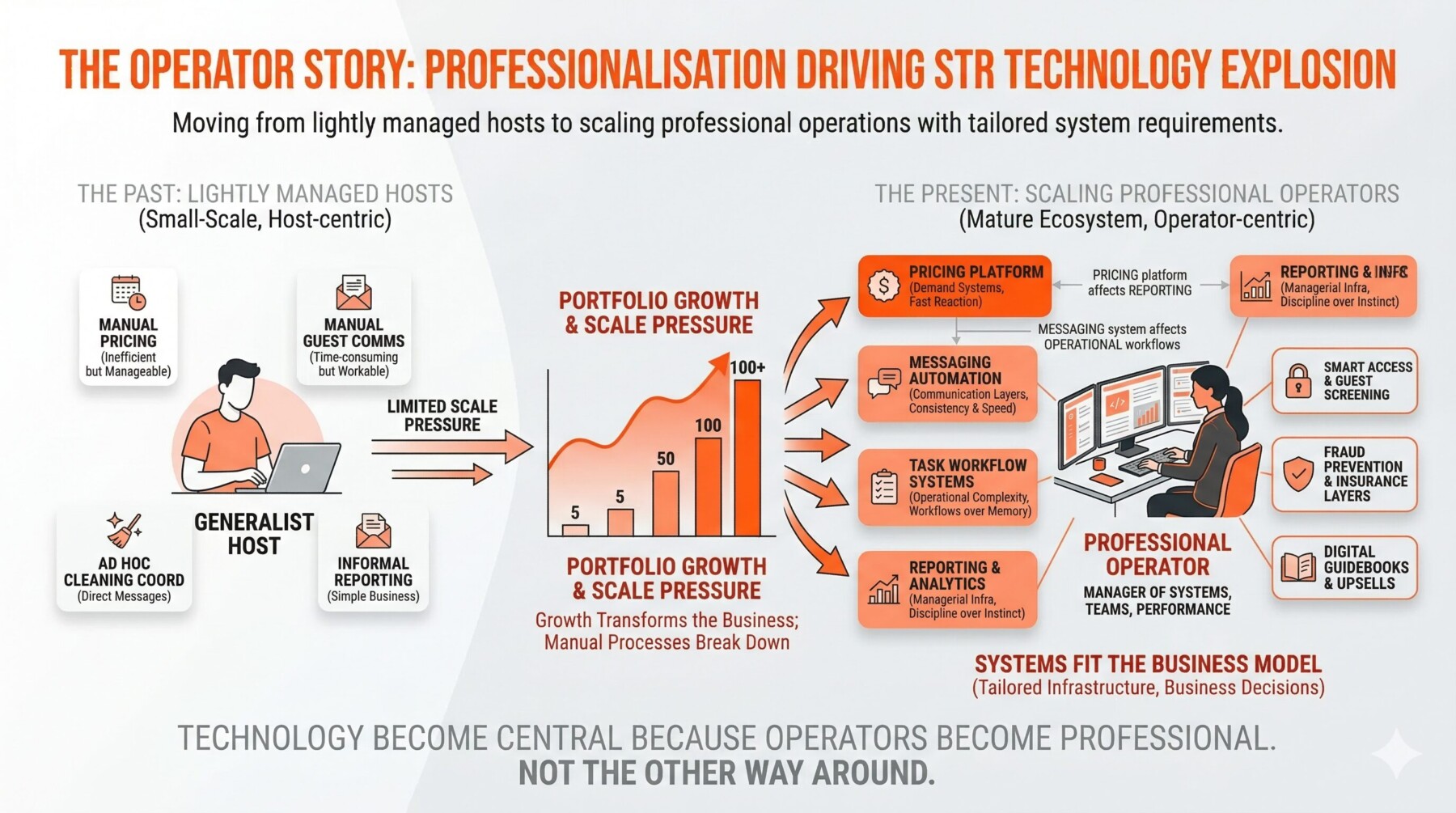
That is one of the reasons the change can be hard to see clearly while it is happening. Most operators do not wake up one day and decide to build a complex software environment. They make sensible decisions over time in response to immediate operational needs.
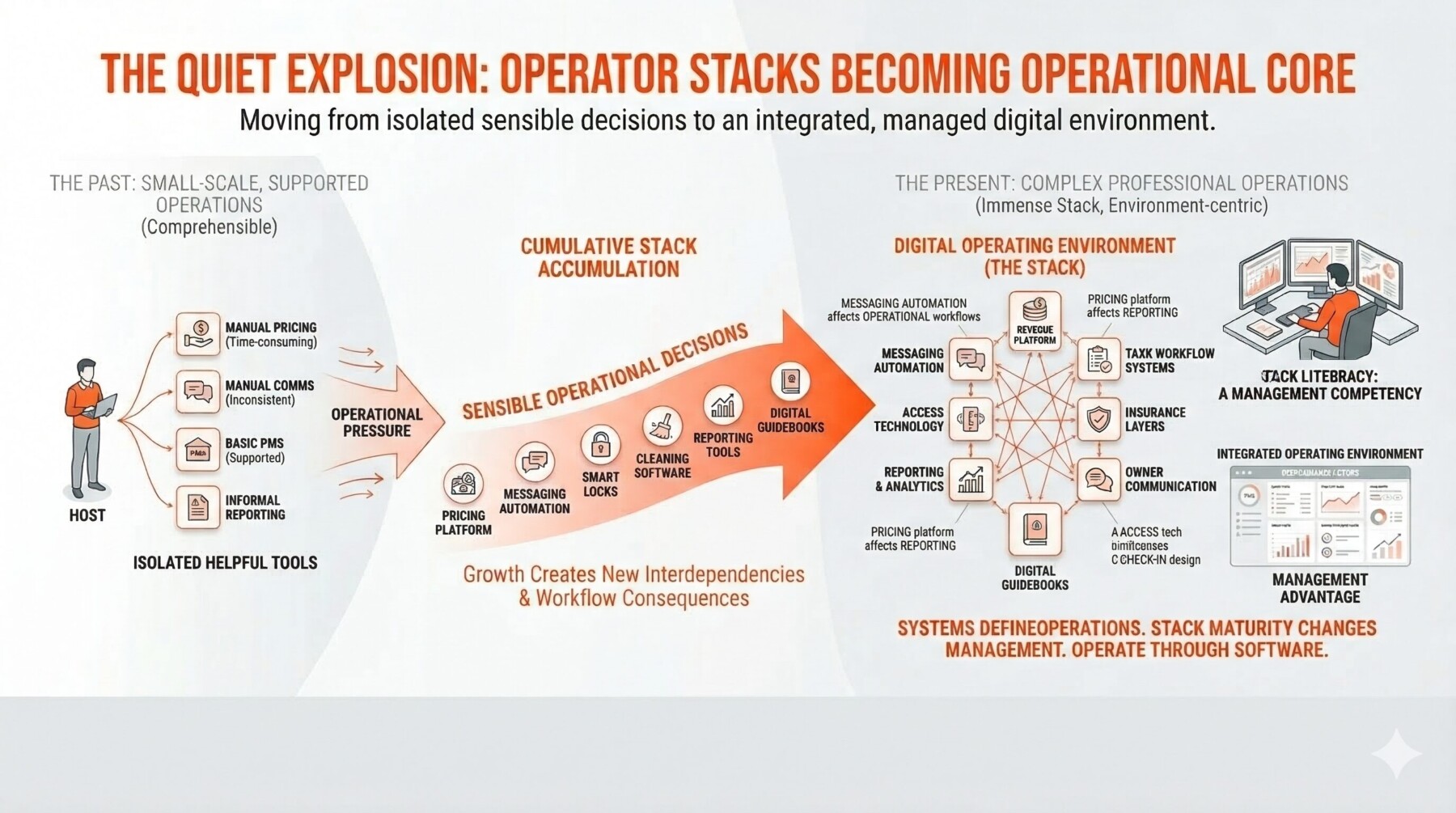
A pricing platform is introduced because revenue performance feels too exposed to manual adjustments. Messaging automation is added because communication volume becomes difficult to maintain consistently across channels. Smart locks reduce operational friction at check-in. Cleaning software improves visibility across teams and turns. Reporting tools are introduced once the business needs clearer performance insight. A digital guidebook appears because guest support can no longer depend on repeated manual explanations.
The cumulative effect
Each choice is rational.
The problem is not with any one decision. The problem is that their cumulative effect is often underestimated.
Over time, what began as a set of helpful additions became a stack: a collection of interdependent systems shaping how the business actually runs.
For many operators, that stack now extends across revenue, communication, operations, access, reporting, guest experience and sometimes owner-facing layers as well. In practical terms, it is increasingly normal for professional operators to rely on seven, eight, ten or more systems in some meaningful way.
That number should not shock anyone. In other digital sectors it would barely raise an eyebrow.
What makes it significant in STR is that the market has reached that level of stack complexity without yet fully developing the shared language, frameworks or habits that usually accompany it.
This matters because the stack changes the nature of management.
When software starts shaping the business
A business built around two or three systems still feels relatively comprehensible. The operator can hold most decisions in their head. System relationships are visible. Dependencies are limited.
A business built around ten systems is different.
At that point, software does not simply support the operation. It shapes it.
One platform affects data quality. Another affects guest response standards. Another influences internal workflows. Another determines how quickly operational issues surface. A change in one part of the stack may have consequences elsewhere that are not immediately obvious.
From tools to environment management
This is the quiet explosion that deserves more attention.
The growth of the operator stack is not just a story of more tools. It is the transition from software usage to environment management.
Once the stack reaches a certain size, operators are no longer just adopting products. They are managing a digital operating environment with all the messiness that implies: overlaps, dependencies, integration assumptions, workflow consequences, and the constant risk that what looked efficient in isolation may create friction in combination.
The gap between buying and reality
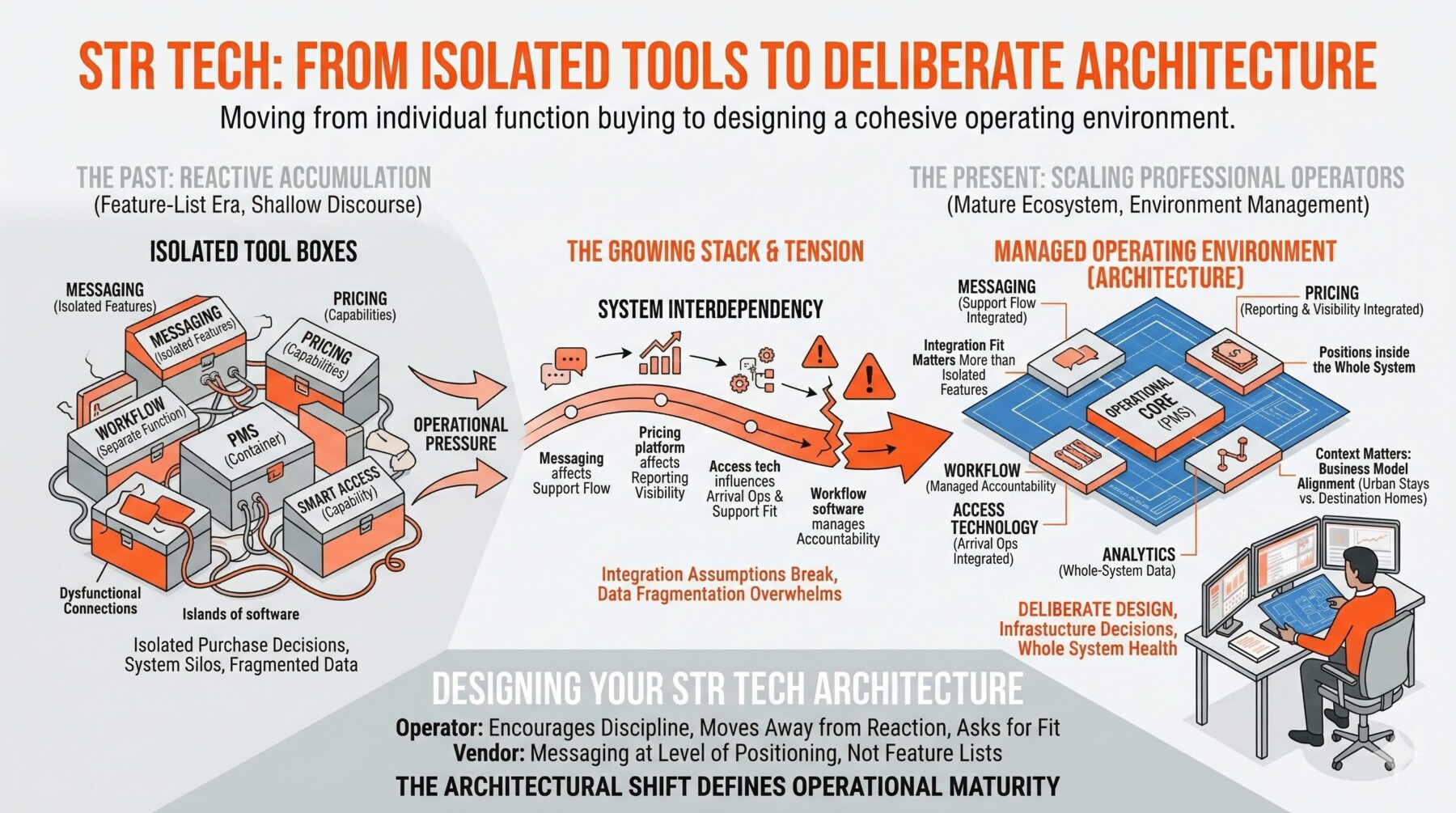
This is why the stack often becomes more complicated than the buying process suggests. Software is frequently evaluated category by category — pricing, messaging, locks, workflows, analytics. But the business experiences those choices as a whole.
That gap between category-by-category buying and whole-system consequence is where many operators begin to feel tension.
A tool can be “good” and still be wrong for the environment around it. A process can be “automated” and still create complexity elsewhere. A stack can be functional and still be poorly designed.
The maturing operator increasingly senses this, even if the vocabulary for describing it is still developing.
What many STR businesses are managing now is no longer a toolkit. It is a stack.
And once the stack becomes central to performance, the ability to understand it becomes an operational advantage in itself.
That is why stack literacy is likely to become one of the defining management competencies of the next phase of the industry. Not because operators need to become technical specialists, but because they need to understand the consequences of the environments they are building.
The quiet explosion of the operator stack is not just something that happened.
It is something the industry now needs to learn how to think about properly.
In the next article, we take that one step further: when does software selection stop being a buying exercise and start becoming architecture?
Reflect on how your stack has evolved & what your current stack is actually enabling.
Follow SCALE Connect on Linkedin