A great deal of discussion around STR technology starts in the wrong place.
It starts with the vendors.
New categories. New tools. New product launches. New integrations. New claims about automation, efficiency and scale.
All of that is visible, so it dominates the conversation. But it is not the deepest explanation for why the technology market looks the way it does.
The real driver: operator evolution
The deeper explanation is that property management itself changed.
The technology story is, fundamentally, an operator story.
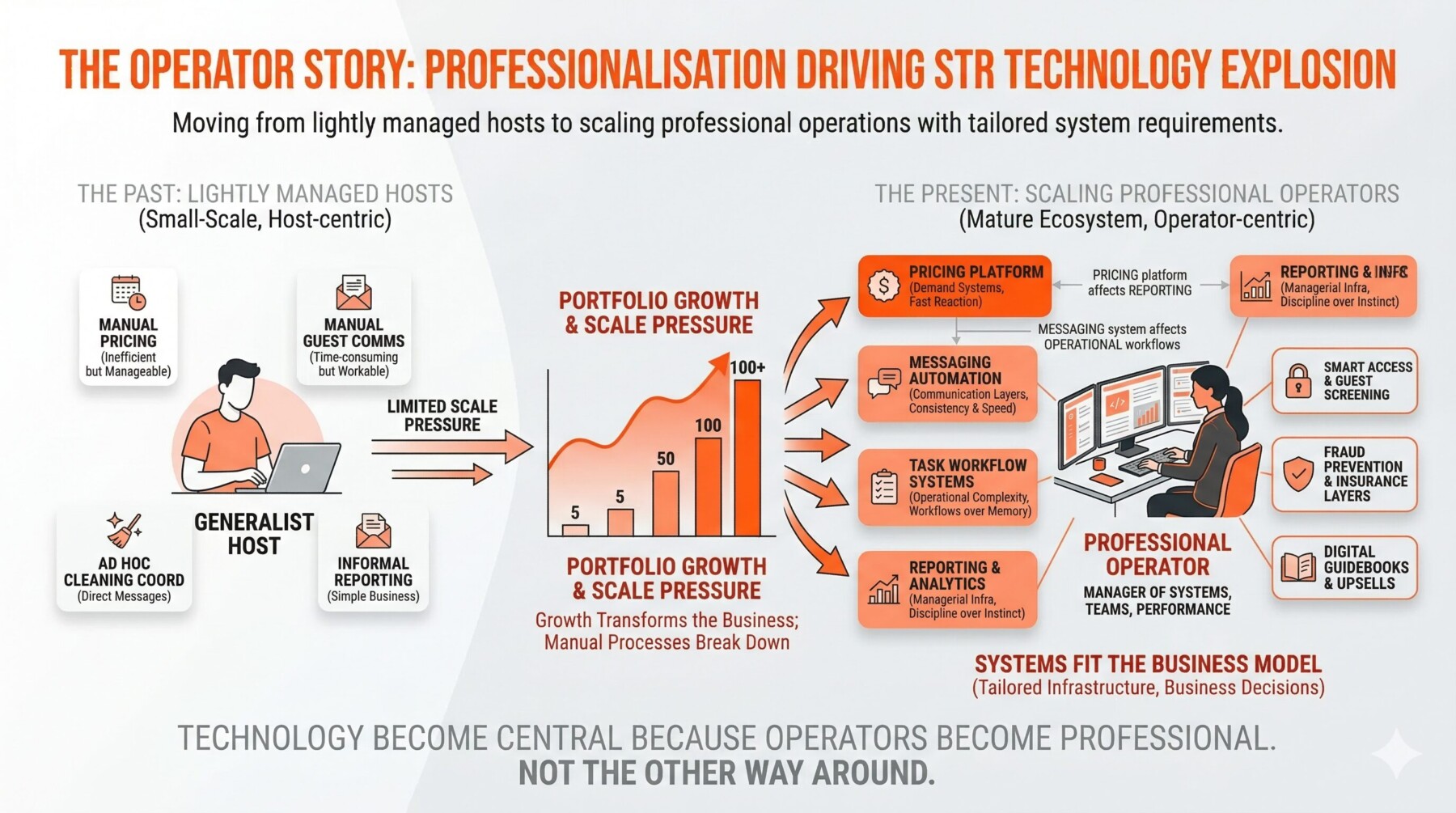
As long as short-term rental remained largely a small-scale, lightly managed sector, the pressure to build complex systems was limited. Manual pricing was inefficient but manageable. Guest communication was time-consuming but not unworkable. Cleaning could be coordinated through direct messages and ad hoc planning. Reporting was often informal because the business itself remained relatively simple.
When scale changes everything
That environment could not survive scale.
Once portfolios grew, and once the market became more competitive, the tolerance for manual, fragmented or reactive processes declined rapidly. This was not a matter of preference; it was a matter of operating reality.
A business managing fifty units does not merely do “more” of what a business managing five units does. It becomes a different kind of organisation.
The same is true at one hundred units, and again at several hundred.
At each stage, coordination becomes more structured, service expectations become more demanding, owners require more visibility, and performance has to be understood with greater discipline. Pricing must adapt faster. Communication must become more consistent. Cleaning and maintenance need systems rather than memory. Decision-making moves from instinct towards process.
The shift to professionalisation
This is the point at which professionalisation changes the market.
Property management begins to behave less like an informal hospitality activity and more like an operating business with systems requirements.
Technology follows that shift.
Not because software “drives” the market in some abstract sense, but because the operating model creates pressure that manual processes cannot absorb. A pricing platform becomes necessary because static pricing weakens performance. Messaging automation becomes necessary because communication volume outgrows the team’s available capacity. Task workflows become necessary because operational complexity exceeds what can be managed casually.
Seen in this light, the explosion of STR technology is not surprising at all. It is a rational response to the growth and professionalisation of the operator base.
That matters for two reasons.
First, it explains why the market has become more specialised so quickly. As operators matured, software vendors were able to build for narrower and more defined use cases. A market of small hosts produces generalist solutions. A market of scaling professional operators produces segmentation.
A new way to evaluate technology
Second, it changes how software should be evaluated.
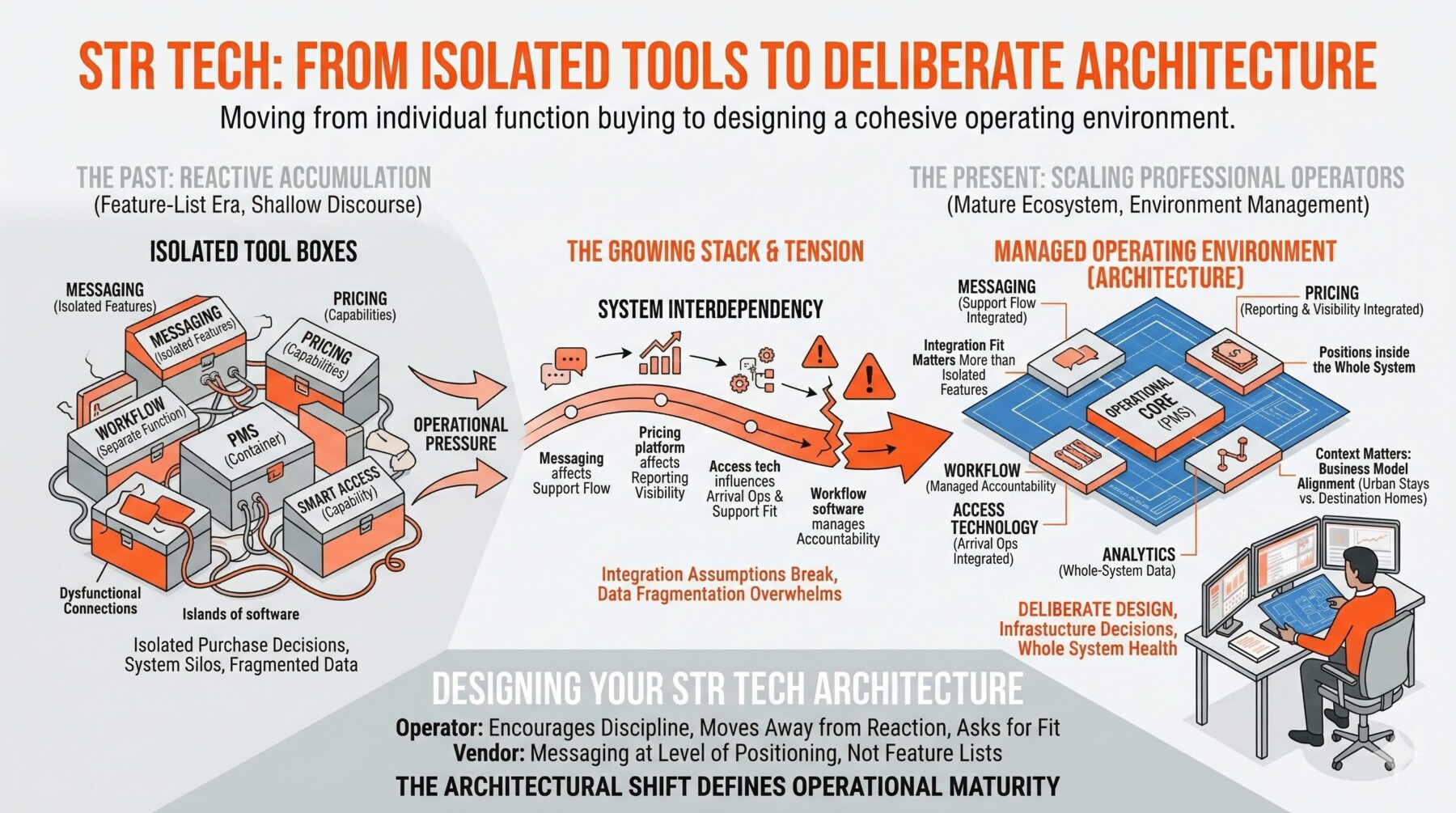
In a less mature industry, software can be discussed mainly in terms of features. In a more mature industry, software needs to be understood in relation to the business model it supports. A company managing urban apartments with high turnover faces different realities from one managing destination homes with longer stays. A business with centralised operations evaluates workflow tools differently from one built around local teams. Premium guest service businesses prioritise different layers of the stack than operationally lean managers focused on throughput and margin.
There is no “best tool” in the abstract. There are only systems that fit a given operational design better or worse.
That is why professionalisation changed the technology game so decisively. It shifted the basis of technology choice from convenience to fit, from feature lists to operating models, and from isolated purchases to infrastructure decisions.
The market has not fully caught up with that shift in the way it talks about itself. A great deal of software discourse in STR still sounds as though the buyer is a simple host looking for a functional tool. But for a growing part of the professional sector, that is no longer the real buyer. The buyer is a manager of systems, workflows, teams, service levels, owner expectations and portfolio performance.
That buyer thinks differently.
And as the industry continues to mature, vendors who understand that shift will position themselves more intelligently, while operators who understand it will make better technology decisions.
The core truth is simple: technology became central because property management became more professional.
Not the other way around.
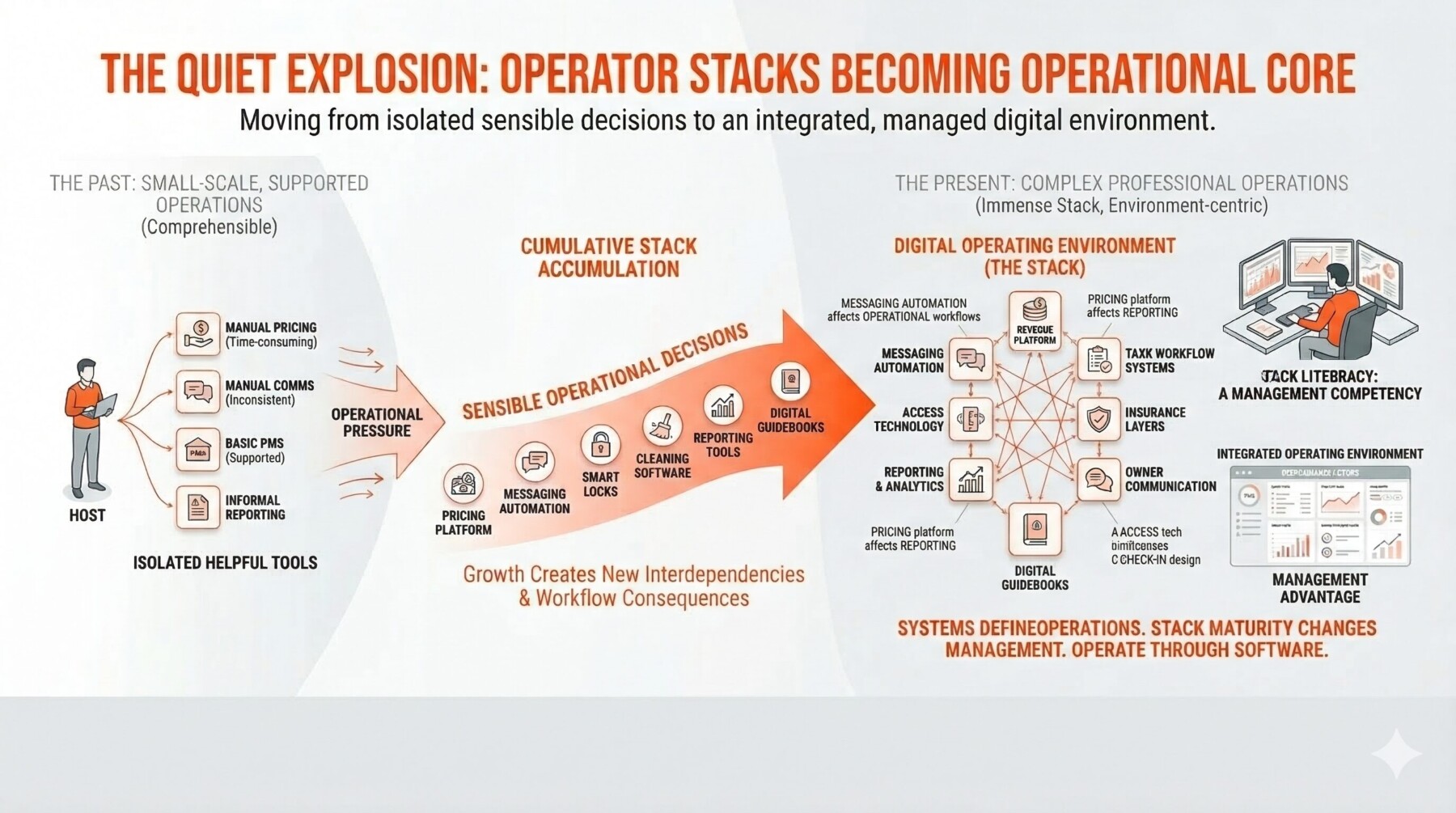
In the next stage of this series, we look more closely at what that professionalisation has produced in practice: the rapid growth of the operator technology stack.
Let´s explore how operator maturity is reshaping the ecosystem.
Follow SCALE Connect on Linkedin