In the STR industry, there is a tendency to assume that operational life becomes easier as businesses become more established.
The logic sounds plausible. Small operators struggle because they lack scale, resources, and process. Larger operators should therefore be more stable, more disciplined, and better structured.
Sometimes that is true.
The assumption that scale brings stability
But in practice, one of the hardest stages in property management is not the very beginning. It is the middle.
The in-between stage.
The stage where the business is no longer small enough to be run informally, but not yet structured enough to behave like a mature operation. This is where many of the industry’s most persistent tensions sit.
Where friction starts to build
At this stage, founders often still carry significant operational knowledge personally. Processes exist, but not always consistently. Technology is present, but its role is uneven. Teams are larger than before, but coordination may still depend too heavily on direct intervention. Reporting is more frequent, yet not always decision-useful. Software categories have multiplied, but the logic behind the stack remains partly reactive.
It is an awkward but important phase. And it is often the stage at which the business feels least elegant.
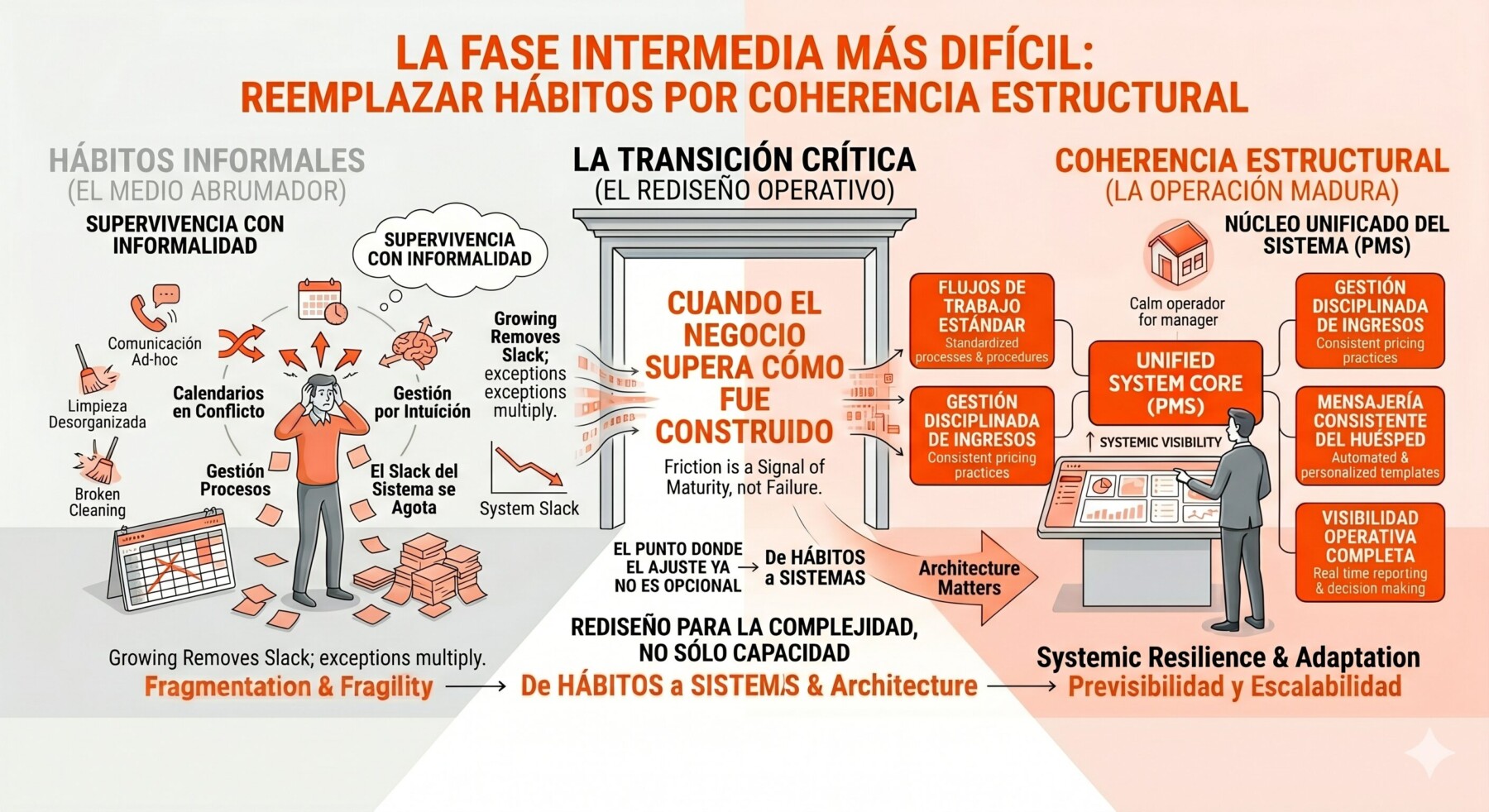
When the business outgrows how it was built
The reason is simple. In between, businesses are trying to operate at a level of complexity that their internal systems have not fully caught up with. They are often managing a scale of activity that now requires more deliberate design, yet they still carry habits, assumptions, and structures from an earlier stage.
That creates strain.
Pricing practices become inconsistent because commercial discipline has not evolved as fast as portfolio size. Communication becomes patchy because the team has outgrown informal habits but not yet fully standardised service processes. Operations become harder to monitor because tasks are now distributed across people and properties, but visibility systems are incomplete.
From the outside, these businesses may look successful. They are growing, hiring, signing properties and moving forward. From the inside, however, they often experience a persistent sense of friction. The business works, but it feels harder to run than it should.
That feeling is usually a sign that the operating model has not fully caught up with the scale of the business.
This matters because mid-scale tension is often misdiagnosed. Operators may assume they need more staff, more effort or another tool. Sometimes they do. But often the deeper issue is that the business has crossed a threshold where piecemeal fixes no longer solve structural misalignment.
What is needed is not just capacity. It is coherence.
That coherence can involve process design, team structure, reporting rhythm, clearer operating standards and, yes, better systems. But the critical point is that the business is no longer asking small-company questions. It has entered a stage where architecture matters.
This is why the middle is so difficult.
Small businesses can survive with informality. Mature businesses can survive with structure. In-between businesses are trying to function with a mixture of both, and that is where hidden fragility emerges.
For vendors, this stage is especially important to understand. The mid-scale operator is not simply a larger version of the small one. Their pain is different. They are often less interested in isolated product features than in whether something will help create stability inside an increasingly complicated operation.
For operators, recognising that the “hard middle” is a normal stage can itself be useful. It reframes friction as a signal of maturity rather than a sign of failure. The business is not necessarily broken. It may simply have outgrown the assumptions on which it was built.
The point where adjustment is no longer optional
The middle is difficult, not because the business is failing, but because it has outgrown the way it was built.
At that point, the question is no longer how to keep things working. It is whether the business is ready to be redesigned to match its own complexity.
Follow SCALE Connect on Linkedin