
Spanish Cities Risk €2 Billion Shortfall by Under-Taxing Tourist Apartments on New Waste Mandate

Posted on - November 26th 2025

Spain’s major urban centers are facing widespread fiscal and environmental inequity by failing to accurately classify and tax short-term tourist apartments (TAs) under a new national waste management fee. Despite a mandate to implement fees based on the “polluter pays” principle, most large cities are treating high-traffic vacation rentals identically to ordinary family homes, effectively subsidizing the waste generated by tourism at the expense of local residents.
The National Mandate and the Revenue Gap
The issue stems from Law 7/2022 on Waste and Contaminated Soils for a Circular Economy. This law, which aligns with European Union directives, required all Spanish municipalities to implement a non-deficit, specific waste fee (Tasa de Basuras or PPPNT) by April 10, 2025. The core objective is to recover the full, real cost of waste collection, transport, and treatment—an estimated €5.056 billion nationally in 2024.
However, a provisional analysis by the Waste Tax Observatory indicates that, even with the new fees, only about 54.7% of these costs were covered in 2025. Local tax inspectors estimate the potential national shortfall to be around €2,000 million. This enormous deficit is largely borne by increasing fees on domestic households, where the average tax has already risen by 26.5% in 2025.
The Major City Blind Spot
In key metropolitan areas, the failure to differentiate between residential and tourist properties exacerbates this financial and social imbalance.
Experts, including fiscal analysts, argue that this practice distorts market fairness, as the high-turnover nature of tourist housing requires oversized and more frequent collection services, much like hotels and restaurants, which already pay premium commercial rates.
The Reality of Tourist Waste Generation
Studies confirm the environmental and fiscal burden:
-
Higher Output: Research indicates that tourism activities often lead to higher quantities of solid waste. While some localized studies (like in Menorca) suggest tourists may generate slightly less per day than residents, the key factor is the composition and recycling behavior.
-
Poor Recycling Rates: Fiscal inspectors note that tourist renters, unfamiliar with complex local separation systems, produce more mixed refuse and recycle significantly less. For instance, in island contexts, non-tourist populations have been found to selectively collect 47.3% more recyclables than tourists.
-
Apartment Impact: Waste audits have specifically shown that mixed-waste generation is higher in tourist apartments than in hotels, due to the structural nature of the services provided.
Crucially, the new law allows municipalities to justify higher fees with studies proving this elevated output, shifting the property’s classification from residential to commercial (economic activity).
Models for Equitable Taxation
While most major cities lag, several administrations are setting the benchmark for equitable waste taxation:
-
Barcelona’s Reclassification: The Área Metropolitana de Barcelona (AMB) is leading the way by planning to reclassify 11,664 tourist apartments as commercial entities for the 2026 budget. This single change is projected to boost municipal revenue by €3.3 million, ensuring that the properties generating commercial-level waste pay commercial-level fees.
-
Sevilla’s Tiered System: Sevilla distinguishes itself among large cities by applying supplements based on both location and capacity, adding up to five euros extra per spot quarterly in prime, high-demand tourist streets.
-
Palma de Mallorca’s Hotel Rates: Palma, recognizing the accommodation sector’s nature, has chosen to apply rates similar to those charged to small hotels, with different tiers depending on whether the unit offers dining services.
This gap signals an urgent need for widespread reform. As Spain’s vacation rental boom continues to strain public services, ignoring this waste tax disparity undermines the very cost-recovery goal set out in the national law, effectively risking publicly subsidized tourism until municipal budget ordinances are corrected for 2026.
Related Articles

Data & Market Trends
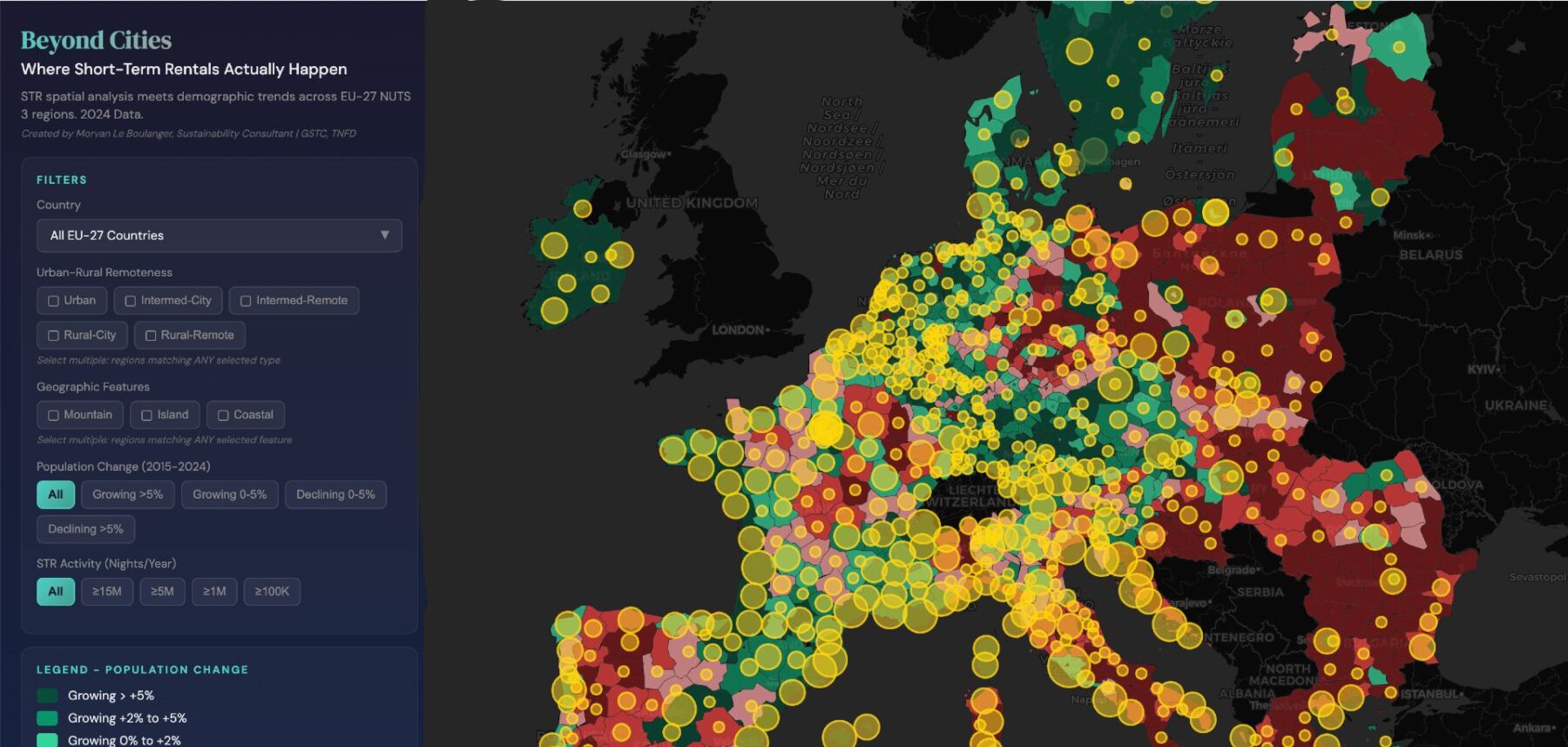
Beyond Cities: Where short-term rentals actually happen
More than half of Europe’s short-term rental activity happens outside cities. A data-led look at STR geography and destination management.
Fresh from the press
Data & Market Trends
Beyond Cities: Where short-term rentals actually happen
More than half of Europe’s short-term rental activity happens outside cities. A data-led look at STR geography and destination management.