The Hidden Economics of Complexity: Why Fragmentation is Your STR’s Quietest Cost
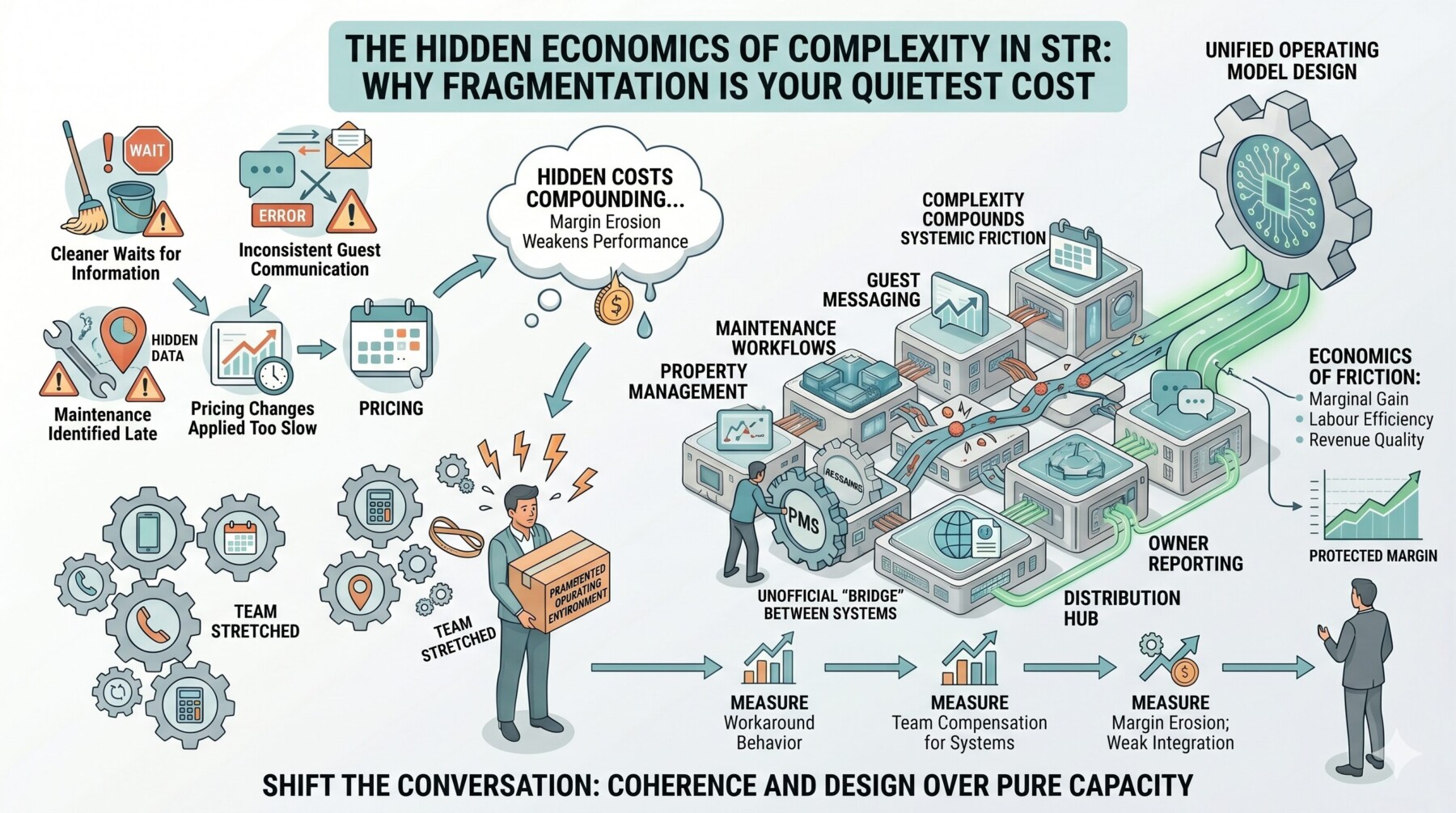
One of the reasons complexity is so difficult to manage in the short-term rental (STR) industry is that it rarely arrives as a single, obvious cost. Instead, it shows up in fragments. It is the cleaner waiting for information that should have been accessible, the guest receiving inconsistent messages because the tech stack isn’t syncing, and the maintenance issue is identified too late because visibility is partial.
When a staff member becomes the unofficial “bridge” between misaligned systems, reporting lags and decisions are made on incomplete data. On their own, none of these issues looks dramatic. That is precisely why they are dangerous: complexity becomes expensive long before it becomes visible.
The Anatomy of Compounding Pressure
Operators often recognize the pressure emotionally before they analyze it. The team feels stretched, exceptions feel constant, and standards become harder to maintain. Small operational issues create disproportionate stress. When this happens, the business isn’t just experiencing a higher workload; it is battling unmanaged complexity.
If the problem is misdiagnosed as purely a “capacity” issue, the response is often to hire more people or add another tool. However, if the business has become structurally more complex than its systems can support, adding capacity only masks the deeper problem.
The Five Pillars of Complexity Cost
The hidden financial drain of complexity usually accumulates in five specific areas:
-
Response Quality: Fragmented environments make it nearly impossible to maintain consistency in guest communication, service recovery, and team handovers.
-
Decision Speed: When data is scattered or manually compiled, revenue and staffing decisions are made with significant lag.
-
Coordination Overhead: Team members spend their most valuable hours reconciling systems and chasing updates rather than moving the business forward.
-
Dependency Risk: The operation becomes vulnerable by relying on a few “key” individuals who are the only ones who understand how the fragmented stack actually functions.
-
Quiet Margin Erosion: Small inefficiencies in pricing, workflow, and timing compound. It rarely creates a crisis, but it makes a meaningful difference to the bottom line.
From Operational Annoyance to Economic Issue
A stack that creates friction doesn’t just make life harder; it directly influences revenue quality and labor efficiency. In more mature industries, complexity is something that must be designed for, not merely endured. The STR industry is now entering that territory.
This shift requires a new approach to measurement. While most operators are excellent at tracking top-line performance (occupancy, ADR, RevPAR), they are often less precise when measuring the economic impact of friction within the operating model itself.
-
How much time is lost to “workaround” behavior?
-
How often are teams compensating for systems rather than being empowered by them?
-
How much margin is eroded by delayed visibility or weak integrations?
The Structural Reality
Complexity does not become expensive only when something breaks; it becomes expensive when the business stops seeing the cost clearly. When friction is accepted as “normal,” inefficiency stops being temporary—it becomes structural. The winners in the next era of STR will be those who stop enduring complexity and start architecting against it.
Follow SCALE Connect on Linkedin