One of the most common mistakes in STR is to think of growth as a simple matter of volume. More units. More bookings. More guests. More owners.
Growth is often framed as volume
That is true at the surface level, but it misses the more important shift underneath. At a certain point, growth does not just make the business bigger. It changes the operating model entirely.
At some point, the model stops scaling cleanly
A manager running eight units does not face the same kind of business as one running eighty, even if both describe themselves as “property managers”. The second business is not simply doing more of the same work. It is dealing with a different order of operational reality.
This distinction is one of the reasons so many operators feel a visible increase in complexity somewhere between early traction and structured scale.
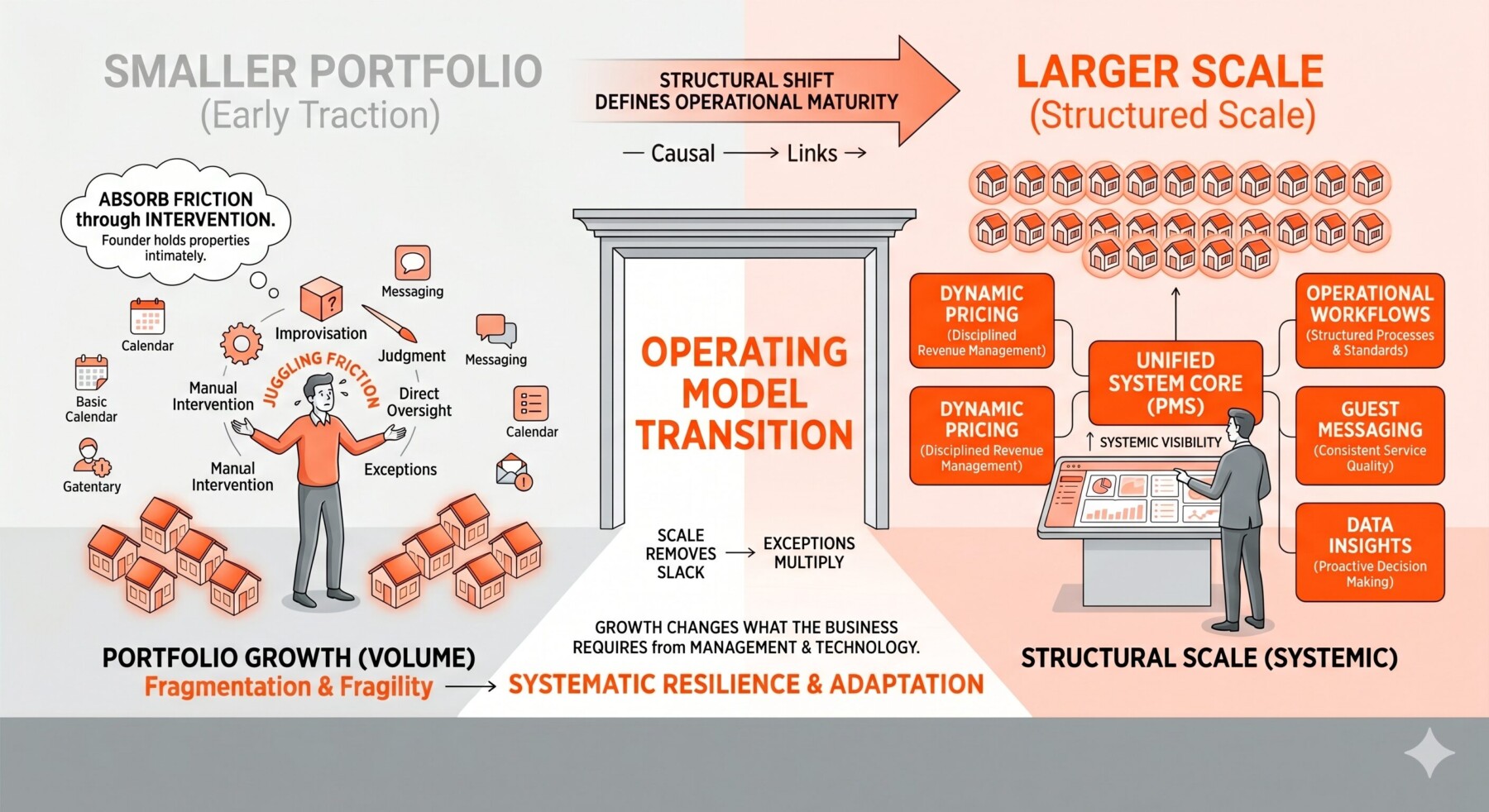
In smaller portfolios, friction can often be absorbed through judgment, memory, direct oversight, and a degree of improvisation. A founder still knows the properties intimately. Team communication is lighter. Exceptions can be handled manually. There is enough slack in the system to rely on intervention rather than design.
That works, up to a point.
When the scale removes slack
Once portfolio size increases, exceptions multiply faster than intuition can manage. One delayed cleaner, one maintenance issue, one guest complaint, one pricing error and one missed handover no longer sit as isolated incidents. They begin to interact. The cost of inconsistency rises. The need for structured workflows becomes more urgent.
This is the stage at which many businesses discover that what feels like “growth” is actually an operating model transition. The business becomes less personal and more systemic.
Processes that were once optional become necessary. Revenue management must become more disciplined because portfolio performance is now sensitive to small inefficiencies. Messaging needs to become more consistent because service quality cannot depend on who happens to be available. Operations need visibility because problems hidden in one part of the portfolio quickly create knock-on effects elsewhere.
In other words, scale changes what the business requires from management.
Technology starts to carry more responsibility
It changes what the business requires from technology. Many operators continue buying software as though the company were still in an earlier stage of maturity. They choose systems to relieve immediate pain, but not always with a clear view of what kind of operating model they are moving into. The result is often a stack that made sense for the business they were, rather than the business they are becoming.
That mismatch explains a great deal of the tension operators feel during growth phases.
A stack built to reduce administrative pressure in a smaller environment may not support operational clarity at a larger scale. A tool selected because it was easy to implement may not hold up once workflows need to be standardised across teams. A pricing process that worked at ten units may quietly destroy performance at fifty.
The question shifts from tools to the operating model
This is why growth stages matter more than many technology conversations acknowledge. The right systems are not simply a function of category. They are a function of the operating model. That means buyers need to ask a harder question than “Which tool should we add?”
They need to ask, “What kind of business are we now running, and what kind of operational discipline does that business require?”
This is also where many vendors misread the market. They sell products into pain points, which is understandable, but the deeper buying context is often stage transition. The buyer is not only trying to fix a problem. They are trying to adapt to a different business reality.
That reality deserves more explicit attention.
The sector often talks about scale in celebratory terms — more units, stronger growth, expansion into new markets. All reasonable. But less attention is paid to the fact that scale is also a structural test. It exposes whether the underlying operating model is coherent enough to support itself.
Technology plays a central role in that test, but not in isolation. Software can strengthen a growing business, but only if it fits the stage of maturity the operator has actually reached. Otherwise, it risks doing what a lot of “helpful” systems do in growing companies: reducing pressure in one area while quietly increasing fragility somewhere else.
Growth does not just increase activity. It changes what the business requires to function well.
And that is where many operators realise they are no longer scaling the same company — They are running a different one.
Follow SCALE Connect on Linkedin