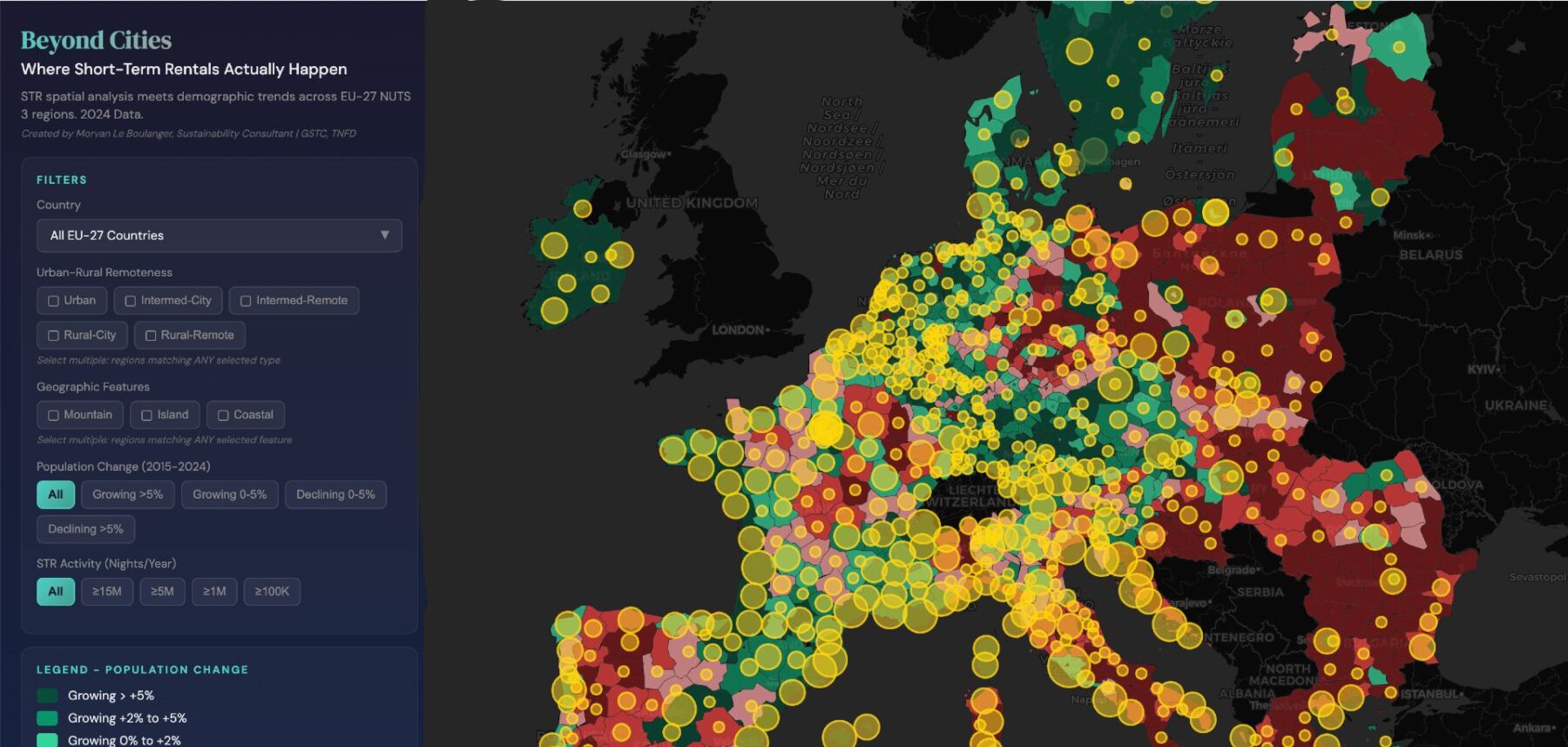

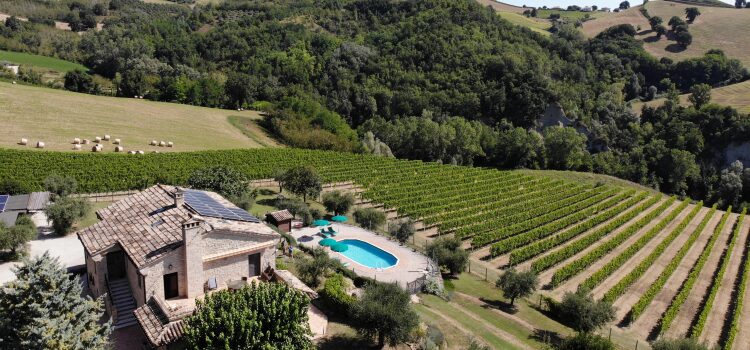
Beyond Cities: Where short-term rentals actually happen
More than half of Europe’s short-term rental activity happens outside cities. A data-led look at STR geography and destination management.
Some people have told me that most businesses in the short-rental industry are just in it for the money. They don’t care about sustainability.
I don’t believe that. I’m sure there are many PMCs and owners who care deeply about the destinations they promote and about the future that awaits their loved ones. If that’s you, I invite you to read this article.
Here’s the topics I have explored:
I think many in the STR industry just don’t see how they can engage in sustainability and run a profitable business at the same time. Particularly in an industry that is still defining itself and seems to be facing challenges from all angles.
Also they don’t have concrete evidence that if they embrace sustainability, it will be compatible with making a profit. This is true for any new trend. Look at AI, the hottest topic right now. Are there really reliable metrics that prove AI will increase your profits exponentially?
When you set up your business, did you know for certain that you would be successful and profitable?
Sustainability is the same. When you decide to launch a business in a young industry, you’ll never have all the proof you need. But that doesn’t stop founders taking that intuitive leap of faith. The added advantage of including sustainability in your business and marketing strategy is that you will have an impact over and above just profit.
Sustainability is not actually a trend. It’s not going away. The world is undoubtedly moving in that direction as we experience a warming planet and a declining natural world. Those businesses who’ve had the foresight to get started recognise that. And if we look at tourism overall, we see that more and more hospitality businesses are viewing sustainability as an integral part of a resilient model.
In this article, I want to show you that you don’t have to see sustainability as something separate from your business strategy. It is not something that will take you away from your core business, sucking up budget and resources.
Business and marketing planning is about considering the present and the future. Then making informed decisions which will give you a better chance of financial success. And more than that, I do believe that entrepreneurs have their own motivations which go beyond making a profit. Sustainability can certainly be part of that, without you even realising it.
But enough of telling you that you should embrace sustainability! Let me show you how it can be part of the solutions to the challenges you face.
To identify your pain points as a property management company, I’ve explored the topics discussed at SCALE shows, in this SCALE Community and taken stats from Guesty’s 2024 STR Industry Report.
In the Guesty report, they cited market saturation as the top concern at 58%. There are undoubtedly certain destinations which are at saturation point. Competition has probably never been fiercer alongside increasing anti-tourist protests. Although, interestingly, the 2025 Booking.com Travel & Sustainability Report discovered that:
“More than half of locals (57%) are positive about tourism’s impact where they live and only 16% of locals believe that capping the number of visitors is the answer.”
What is the secret to standing out from the competition? It’s not difficult – you need to differentiate yourself. This is the foundation of marketing strategy.
This can be difficult when you’re offering a portfolio of properties which is similar to others in your destination and you don’t want to go down the slippery slope of being the cheapest.
Sustainability can truly be your friend in creating brand differentiation. And when I say “sustainability”, I don’t just mean reducing carbon emissions. To me that’s the “unsexy” part and a no-brainer as you should save money. I’m referring to the other two important parts of sustainability. Respecting people (local cultures and guests) and protecting nature.
You’re probably doing something for these two aspects already. STRs are very good at supporting local businesses which is probably why over half of locals see tourism as a positive. It could well be higher than this if locals were only asked about vacation rentals. There will be local community projects that need support. And that doesn’t always have to be financial. Giving staff time off to volunteer can be a great employee benefit. Much more meaningful than a free gym membership!
When it comes to nature, there will undoubtedly be a local project which you could support in numerous ways. If your focus is properties in coastal locations, there are so many ways to be involved in protecting the ocean. You can even involve guests too as part of their stay. If you’re in the mountains, climate change is wreaking havoc on ski seasons. If you’re in the city, there will be projects to attract or protect wildlife and create green, pedestrian areas.
So when you review your value proposition, USP or whatever you want to call it, do think about using some of these ideas to create a different story for your brand.
This is probably the easiest reason to justify adopting sustainable practices. It was second in the Guesty report at 55% as the cost of doing business.
When your owners save on utilities or you help them to do so, you also cut your indirect carbon emissions, waste or conserve water, which has become such a precious resource.
Yes, there will be some investment needed in educating and supporting owners and your in-destination teams. But that’s the same as any initiative and can be phased in gradually. Like replacing bulbs with LEDs or installing energy monitors. It’s all about staying relevant and ahead of the game.
It doesn’t mean that you or your owners have to invest in solar panels and heat pumps. Although some of your owners might like to know more about that, particularly if there are incentives in your target destinations.
As the STR industry is still so young, there are not that many examples of ROI for these type of costs. But watch this space…

A good inventory for guests and satisfied property owners are the lifeblood of a property management company. In the Guesty report, the top concern (67%) for a growth strategy was adding new properties.
Every Booking.com Travel and Sustainability Report tells us that travellers are looking for sustainable places to stay. Now, you could say that if you ask the right questions, you’ll get the answers you want. However, you only have to look at other industries like automotive, fashion, beauty and food to see the shift.
Take a look at my article for this Community “2025 Sustainability Marketing Insights” to explore further.
Potential STR guests are looking for the advantages that sustainability brings (as I said, without having to call them sustainable). Getting to know the destination, experiences with locals (look at Airbnb’s current focus) and expecting accommodation which is acting responsibly.
If you’re looking to keep your existing owners and find new ones, why not help operators lean into traveller expectations. And what about all the new owners who are already incorporating responsible practices like energy efficiency, love and respect for their destination and immersive experiences. Why would they choose your company over another?
As the STR industry is so young, we don’t have specific data to back this up. However, you only have to look at a business like Host and Stay with their ManageGreen initiative which has allowed them to keep growing (40% uplift in revenue in 2024). And they did this from an environmental rationale to reduce emissions and waste not just save money. In fact, they have rediverted most of the savings into other areas where they wanted to do more. They continue to grow not despite of this approach but partly due to it.
So, if a property owner were looking for a new PMC, do you think they would be put off that you were doing the right thing, particularly when you will support them to make cost savings?
Marketing always comes up as key area of attention for PMCs. Not surprising as things change so fast in digital marketing. Continually changing algorithms, new rules for SEO and content, particularly in the light of AI, and the need to stand out in “the attention economy”.
Including sustainability provides a new source of rich content which will resonate with all your stakeholders. It fits perfectly with storytelling and provides that human connection. Importantly, it shows to your potential guests that you’re not just in it for the money. You’re demonstrating that you care about their future as well as local communities and all the people in your value chain.
You don’t have to shout about it or even use the word “sustainability”. Just talk about the guest experience, being responsible and supporting local communities.
Of course, you need to have some of these initiatives to showcase but you’re probably doing a lot of them anyway. It doesn’t mean that you have to increase your marketing budget. You just need to weave sustainability subtly into your content plan and set up some KPIs to monitor its impact accordingly. I’m sure your owners will be a rich source of stories and it will pay to set up ways to facilitate this.

All of the points above are about building and scaling a business which is relevant today and into the future.
As the STR sector is still such a young industry, there is undoubtedly much focus on investment, mergers and acquisitions. When investors evaluate businesses they look at risk as well alongside the competency of the management team.
I would say that if you are ignoring sustainability, it won’t do you any favours. STR investors may not be asking those questions yet although 80% of Gen Z and Millennials say that they plan to increase allocations to sustainable investments.
Investors consider the future and risk. ESG (Environmental, Social, Governance) is increasingly part of that assessment. Will they see you as a responsible, forward-thinking business? Ask yourself these questions:
Also potential investors will examine your team. Another important stat is that Gen Z and Millennials want to work for businesses with purpose. They value learning, meaning and wellbeing.
Again, some questions to ask yourself.
I do hope that some of what I’ve said has resonated with you. And that you can see how sustainability, and being part of something greater, can bring advantages to your business. And also bring you personal fulfilment as an entrepreneur.
Sustainability is not an add-on. It’s just part of any credible business and marketing strategy. Just get started – as you did when you launched your business. I’m convinced you won’t regret it!