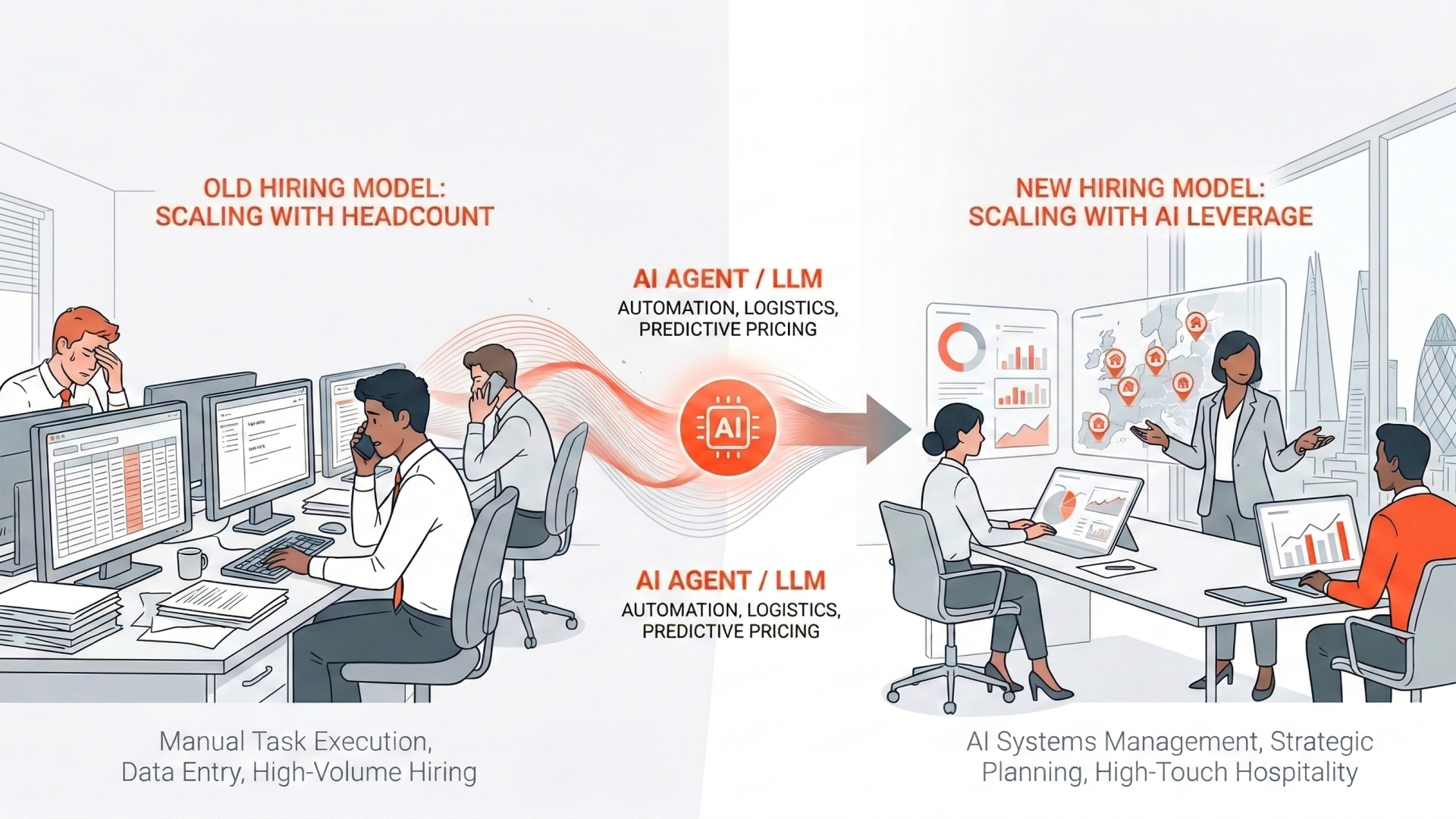
Historically, the short-term rental (STR) industry solved growth problems by throwing headcount at them. If a property manager acquired 50 new units, they immediately hired more reservation agents, more pricing analysts, and more administrative staff to handle the exponential increase in manual workflows.
Today, that linear hiring model is officially obsolete. As autonomous AI agents and Large Language Models (LLMs) become deeply embedded in property management software, the STR hiring mindset is shifting from adding manual capacity to acquiring strategic leverage.
Here is a breakdown of how AI is fundamentally changing what and who STR companies are looking for in 2026.
From Task Execution to Systems Management
For years, entry-level STR roles focused on repetitive task execution: answering “what is the Wi-Fi password?” at 11 PM, manually updating pricing across multiple OTAs, or coordinating cleaning schedules via spreadsheets.
AI now handles these baseline operations instantly and without fatigue. Consequently, hiring managers are no longer looking for people to do the tasks; they are looking for people to manage the AI that does them.
-
The Old Hire: A Guest Communications Agent was measured by how fast they could type out template responses.
-
The New Hire: An AI Systems Architect or Workflow Manager who trains the property’s LLM on brand voice, monitors edge cases where the AI failed, and continually optimises the automated guest journey.
The Rise of the ‘AI-Fluency’ Requirement
Tech literacy is no longer confined to the IT department. Whether a company is hiring a Revenue Manager, a Marketing Director, or an Operations Lead, “AI-fluency” is becoming a non-negotiable core competency. STR operators are actively seeking candidates who understand how to structure data so that AI tools can read it.
For example, in marketing, the right candidate should be able to write semantic SEO content and structure a Schema markup, while in Revenue, the ideal candidate should be capable of building prompt structures to query complex market data.
The most valuable employees are those who treat AI as an intern, knowing exactly how to prompt it, verify its output, and scale its capabilities.
A Premium on ‘Human-Only’ Skills
Paradoxically, as AI automates the digital logistics of property management, the value of profound, high-touch human skills is skyrocketing. When routine operations become invisible and frictionless, the “human touch” becomes the ultimate luxury differentiator.
STR companies are restructuring their payroll to hire for emotional intelligence, local expertise, and complex problem-solving.
-
Crisis Management: AI cannot go to a property to soothe a furious guest whose heating has broken in the middle of winter.
-
Local Curation: AI can scrape the internet for “best restaurants in Barcelona,” but it cannot build a lucrative, handshake partnership with a local boutique vineyard for exclusive guest wine tastings.
Companies are hiring fewer screen-watchers and more on-the-ground relationship builders.
The Bottom Line
The AI revolution in the STR industry does not mean humans are being replaced; it means they are being elevated. The hiring mindset has shifted from viewing employees as biological software meant to process data to viewing them as strategic operators driving growth and authentic hospitality. STR companies that continue to hire for manual task execution will soon find themselves outpaced by leaner, AI-leveraged competitors.